

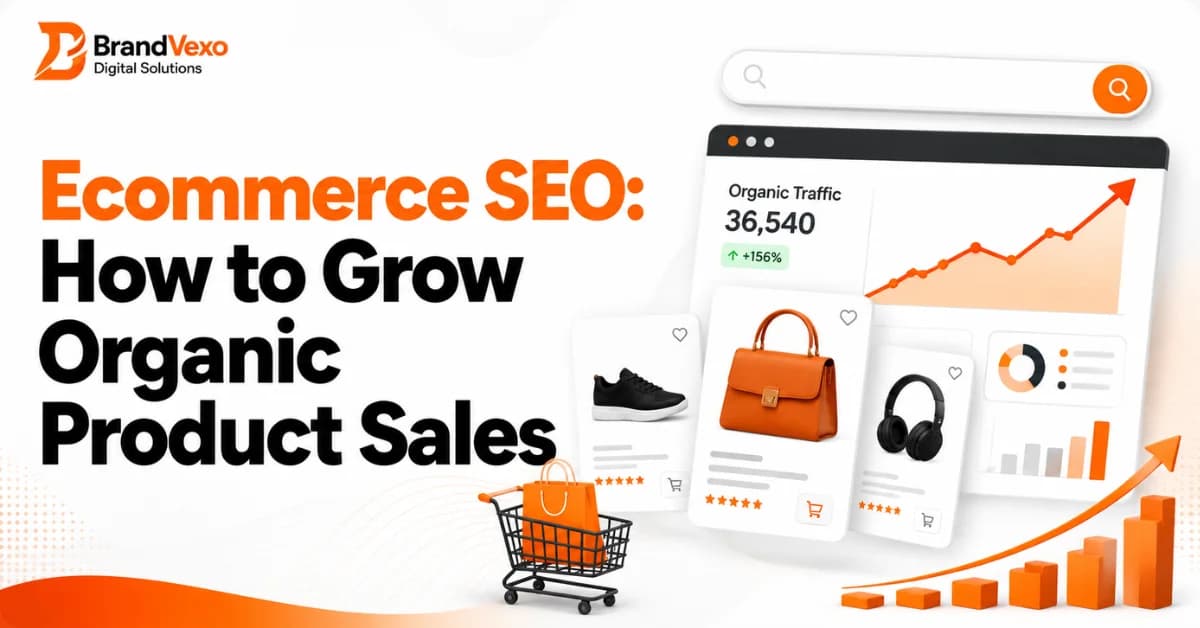
Ecommerce SEO: How to Grow Organic Product Sales
Ecommerce SEO helps online stores attract people who are already searching for products, solutions, brands, and categories they want to buy. But getting organic traffic is only one part of the process. The real goal is to turn relevant search visibility into product discovery, qualified visits, customer trust, and ultimately more sales.
A strong ecommerce SEO strategy connects search intent, category pages, product pages, technical SEO, content, and conversion opportunities. Google’s current ecommerce guidance also emphasizes making products and site structure easy for Google to discover, understand, and crawl.
Whether you run a small online store or a large ecommerce website, the following strategies can help you build sustainable ecommerce traffic and improve organic product sales.
What Is Ecommerce SEO?
Ecommerce SEO is the process of optimizing an online store so that search engines can discover, understand, and display its pages for relevant searches.
Unlike a simple business website, an ecommerce site may contain hundreds or thousands of URLs, including product pages, categories, subcategories, filters, variations, blogs, and informational resources.
That makes SEO more than adding keywords to product descriptions.
A successful ecommerce SEO strategy should help search engines understand:
What your store sells
Which categories matter most
Which products belong to each category
How pages relate to one another
Which products are available
What information shoppers need before buying
Google recommends creating a clear ecommerce structure and making important pages accessible through links and navigation.
How Ecommerce SEO Supports Organic Sales
Think of the customer journey as:
Search → Category/Product Page → Evaluation → Trust → Purchase
For example, someone searching for “wireless headphones for travel” may not be ready to purchase from the first website they see. They may compare features, prices, battery life, reviews, and shipping options.
Good ecommerce SEO helps your store appear when that shopper is researching and when they are closer to making a purchase.
The objective is therefore not simply to rank for more keywords. It is to attract the right ecommerce traffic and provide enough useful information to help visitors take the next step.
Build Your Ecommerce SEO Strategy Around Search Intent
Search intent tells you what a person wants when they enter a query into Google.
For ecommerce websites, common intent types include:
Informational: “How to choose running shoes”
Commercial: “Best running shoes for beginners”
Transactional: “Buy men's running shoes”
Navigational: “Nike running shoes”
Each search deserves the right type of page.
A common SEO mistake is trying to make every page rank for broad product keywords. Instead, match the page to the user's purpose.
Match Keywords to the Right Ecommerce Page
When building an effective ecommerce SEO strategy, it is important to match each keyword with the right type of page based on search intent. Broad product searches such as “running shoes” are generally better suited to a category page that helps shoppers compare different options, while a specific search such as “Nike Air Zoom Pegasus” is more appropriate for an individual product page. Searches combining a brand and product may work best on a product or category page, depending on the query, while comparison searches can be addressed through detailed buying guides. Informational questions are usually better suited to blog posts, guides, or educational content. This approach makes online store SEO more organized, improves relevance between search queries and landing pages, and helps shoppers find the information or products they need more efficiently.
Optimize Your Ecommerce Category Pages
Category pages often sit between your homepage and individual products, making them valuable parts of an ecommerce website's architecture.
Category page SEO should focus on helping users understand the category while making products easy to discover.
A strong category page should include:
A clear and descriptive H1
Relevant category terminology
A short, useful introduction
Helpful subcategories
Internal links
Product listings
Descriptive URLs
Useful filters
Relevant FAQs where appropriate
Avoid filling category pages with large blocks of repetitive text simply to increase word count. The content should help shoppers understand their options.
For example, a category page targeting “women's running shoes” could briefly explain different running shoe types, intended uses, cushioning options, and links to relevant subcategories.
Category Page SEO Example
Imagine an online sports store.
Instead of relying on a generic URL such as:
/category/shoes
the store could organize its information around meaningful categories such as:
/running-shoes/
The category could then connect shoppers to:
Men's running shoes
Women's running shoes
Trail running shoes
Beginner running shoes
Lightweight running shoes
This structure gives users a clearer path through the store and helps search engines understand relationships between pages.
Google recommends linking from important navigation areas to category pages, subcategories, and product pages so its crawlers can discover ecommerce content more effectively.
Improve Product SEO to Help Products Get Found
Product pages are where search visibility can turn into purchase decisions. Product SEO involves optimizing the page around the actual product while providing information that helps customers decide whether it is right for them.
Optimize Product Titles
A good product title should clearly identify the item.
Include useful information such as:
Product name
Brand
Model
Important product attribute
Relevant variant information
Avoid repeating the same keyword unnaturally.
A title such as “Wireless Headphones – Black – 40-Hour Battery” is more useful than repeatedly inserting “best wireless headphones” into every element of the page.
Write Helpful Product Descriptions
Do not simply copy a manufacturer's description.
A useful product description should explain:
What the product does
Who it is suitable for
Key features
Important specifications
Practical benefits
Size, material, compatibility, or other relevant details
What customers should know before ordering
Unique, useful information gives shoppers a reason to stay on the page instead of returning to Google.
Optimize Product Images
Product images are important for both usability and product discovery.
Use:
Clear, high-quality images
Descriptive file names
Appropriate alternative text
Multiple product angles
Product-in-use images when helpful
Compressed images that do not unnecessarily slow the page
Image optimization should improve the shopping experience rather than exist solely for search engines.
Add Accurate Product Information
Keep important details current, including:
Price
Availability
Product variants
Specifications
Shipping information
Return policies
Customer reviews
Accurate information builds buyer confidence and reduces uncertainty.
Strengthen Online Store SEO With Site Architecture
A large ecommerce website can quickly become difficult to navigate if its pages are not organized logically.
A simple structure can look like:
Homepage → Category → Subcategory → Product
This makes it easier for customers to browse and helps search engines understand the relationship between pages.
Google specifically recommends designing ecommerce navigation so important pages can be reached through links.
Create a Strong Internal Linking System
Internal links can connect related content across your store.
For example:
Blog → Category → Product
A buying guide about “how to choose running shoes” could link to a running-shoe category. That category could then link to individual products.
You can also connect:
Related products
Complementary products
Subcategories
Buying guides
FAQs
Brand pages
This creates a useful path for both shoppers and search engines.
Improve Ecommerce Technical SEO
Even excellent content can struggle if search engines cannot efficiently access or understand the website.
Technical ecommerce SEO should address:
Crawlability
Indexation
XML sitemaps
Canonical URLs
Duplicate content
URL parameters
Faceted navigation
Redirects
Broken links
Mobile usability
Page performance
Improve Crawlability and Indexation
Filters can create large numbers of URL variations.
For example, a store selling shoes might generate separate URLs for:
Size
Color
Brand
Price
Material
Rating
Not every variation needs to become a separate searchable page.
Review which URLs provide genuine value and which create unnecessary duplication or crawl complexity. Also check that important category and product pages are accessible through normal navigation and internal links.
Improve Page Experience
Shoppers expect ecommerce pages to work smoothly on mobile and desktop.
Pay attention to:
Page loading performance
Mobile usability
Image size
Layout stability
Unnecessary scripts
Checkout usability
SEO should support a good customer experience rather than treat technical optimization as a separate activity.
Use Structured Data for Ecommerce Product Pages
Structured data helps search engines understand information contained on a webpage. For ecommerce websites, relevant structured data can include Product, Offer, Review, and BreadcrumbList, depending on what the page actually contains.
Google states that Product structured data can make product pages eligible for product-related search appearances, although structured data does not guarantee that a rich result will appear.
For product pages, make sure structured data accurately reflects visible information such as product name, price, availability, and eligible review information.
Google recommends validating structured data and checking how pages are seen through tools such as the Rich Results Test and URL Inspection.
Do not add fake ratings, reviews, prices, or availability simply to gain search visibility. Accuracy is essential for both SEO and customer trust.
Create Content That Supports Product Discovery
Product pages are not the only way to attract organic customers.
Many shoppers start with questions rather than product names.
For example:
“What running shoes are best for beginners?”
is different from:
“Buy men's running shoes.”
The first query creates an opportunity for educational content. The second has stronger transactional intent.
Create Helpful Buying Guides
Useful ecommerce content can include:
Buying guides
Product comparisons
How-to guides
Size guides
Product-use tutorials
Maintenance guides
Product selection advice
For example, a sports retailer could create:
“How to Choose Running Shoes for Beginners”
The guide can explain cushioning, fit, terrain, running frequency, and common mistakes. It can then link naturally to relevant running-shoe categories and products.
This approach allows content to support both discovery and conversion.
Build Topic Clusters Around Products
A store selling running shoes could create a small topic cluster:
Main category: Running Shoes
Supporting content:
How to choose running shoes
Running shoes vs walking shoes
Best running shoes for beginners
How often should running shoes be replaced?
Trail running shoes vs road running shoes
Each useful article can connect to relevant categories and products.
The goal is not to publish dozens of pages for the sake of SEO. Google emphasizes people-first content that provides genuine value rather than content created primarily to attract search-engine visits.
Earn More Ecommerce Traffic With Long-Tail Keywords
Broad keywords can attract large audiences, but highly specific searches often reveal clearer customer needs.
Examples include:
“waterproof hiking shoes for women”
“office chair for tall people”
“wireless headphones with long battery life”
“laptop backpack with USB charging”
These searches tell you more about what the shopper wants.
Find Long-Tail Ecommerce Keywords
Useful research sources include:
Google Search Console
Google Trends
Keyword research platforms
Competitor SERPs
Customer support questions
Product reviews
Website search data
Sales-team feedback
Look beyond search volume.
Ask:
Does this query represent a real customer need that my store can satisfy?
That question can uncover valuable opportunities for ecommerce traffic and sales.
Build Trust Signals That Support Ecommerce SEO
A shopper may discover your product through Google but still leave if they do not trust the store.
Trust signals can include:
Clear business information
Easy-to-find contact details
Shipping information
Return and refund policies
Secure checkout
Genuine customer reviews
Accurate product specifications
Clear pricing
Helpful buying information
Use Customer Reviews as Useful Content
Genuine reviews can help shoppers understand a product from another customer's perspective. They can also reveal questions that your product page may not answer.
For example, repeated comments about product sizing could indicate that the store should improve its size guide.
Do not manufacture reviews or manipulate ratings. Authentic customer feedback provides much stronger long-term value.
Google's guidance emphasizes helpful, reliable content and trust as an important part of E-E-A-T.
Ecommerce SEO Mistakes That Can Reduce Organic Sales
Avoid these common problems:
Optimizing every page for the same keyword
Copying manufacturer descriptions
Creating thin category pages
Ignoring mobile users
Indexing unnecessary filter URLs
Creating weak internal links
Leaving important products isolated
Ignoring discontinued products
Publishing content without a clear customer purpose
Overusing exact-match keywords
Ignoring technical SEO
Measuring only keyword rankings
A page can rank and still generate little revenue if it attracts the wrong audience or provides a poor buying experience.
That is why ecommerce SEO should always connect visibility with customer behavior and business outcomes.
How to Measure Ecommerce SEO Performance
Organic rankings are useful, but they are not the complete picture.
Track metrics such as:
MetricWhat it tells youOrganic clicksHow much search traffic you receiveImpressionsHow often pages appear in searchCTRHow often searchers clickOrganic conversionsWhether SEO traffic produces actionsConversion rateHow effectively traffic convertsOrganic revenueDirect business impactProduct-page trafficProduct discoveryCategory-page trafficCategory visibilityIndexed pagesSearch accessibility
Track SEO Beyond Rankings
A useful ecommerce measurement model is:
Traffic → Engagement → Conversion → Revenue
For example, if a category receives 20,000 organic impressions but very few clicks, investigate the search result presentation and intent match.
If it receives thousands of clicks but produces few sales, investigate:
Product relevance
Pricing
Product information
Page experience
Trust signals
Checkout experience
This approach turns SEO from a traffic-generation activity into a measurable growth channel.
A Practical Ecommerce SEO Action Plan
If you are starting or improving your ecommerce SEO, work through these stages.
Phase 1: Audit
Review:
Technical SEO
Indexation
Existing rankings
Product performance
Category performance
Internal linking
Organic conversions
Phase 2: Optimize
Improve:
Product titles
Product descriptions
Category pages
URLs
Images
Internal links
Metadata
Structured data
Phase 3: Build
Create:
Buying guides
Product comparisons
Helpful informational content
Long-tail content
Topic clusters
Strategic internal links
Phase 4: Measure
Monitor:
Search visibility
Organic clicks
Product traffic
Category traffic
Conversion rate
Organic revenue
Then use the data to decide which pages deserve further optimization.
How BrandVexo Can Help With Ecommerce SEO
At BrandVexo Digital Solutions, ecommerce SEO can be approached as a complete growth strategy rather than a simple keyword-ranking exercise. The focus can include technical SEO, product and category optimization, content strategy, website optimization, internal linking, and organic growth opportunities.
If your online store is receiving traffic but not enough qualified customers, a structured SEO review can help identify where search visibility, user experience, and conversion opportunities are being lost.
Looking to grow your online store through organic search? BrandVexo can help you build a practical ecommerce SEO strategy aligned with your products, audience, and growth goals.
Get in touch with BrandVexo:
Phone: +971 52 356 5409
Email: info@brandvexo.com
Website: www.brandvexo.com
FAQs
What is Ecommerce SEO?
Ecommerce SEO is the process of optimizing an online store's product, category, content, and technical pages so search engines can discover them and shoppers can find relevant products through organic search.
How does Ecommerce SEO increase sales?
Ecommerce SEO can increase sales by attracting relevant searchers, improving product discovery, matching pages to search intent, and making product information easier for shoppers to evaluate.
What is the difference between product SEO and category page SEO?
Product SEO focuses on individual products, including product titles, descriptions, images, specifications, reviews, and structured data. Category page SEO focuses on broader product groups and helps shoppers discover relevant products within a category.
How can I increase ecommerce traffic without paid ads?
Focus on technical SEO, useful category pages, optimized product pages, long-tail keywords, internal linking, buying guides, and helpful content that matches customer search intent.
How long does Ecommerce SEO take to produce results?
There is no universal timeline. Results depend on factors such as site authority, competition, technical condition, content quality, industry, and the number of improvements implemented. SEO should be treated as an ongoing process rather than a guaranteed short-term campaign.
Are product descriptions important for SEO?
Yes. Useful, original product descriptions help shoppers understand products and can provide search engines with clearer information about the page. Avoid copying descriptions from manufacturers or other websites.
Final Takeaway
Effective Ecommerce SEO is not about adding keywords to every product page. It is about creating an online store that search engines can understand, and shoppers can trust. Strong category page SEO, useful product pages, logical site architecture, technical optimization, helpful content, and genuine trust signals can work together to attract better ecommerce traffic and support more organic sales.
Disclaimer: This article is intended for general informational and educational purposes only. SEO results can vary based on industry, competition, website authority, search intent, content quality, and ongoing search engine updates. The strategies discussed do not guarantee specific rankings, traffic, or sales. Businesses should evaluate their individual website, audience, and goals before implementing an SEO strategy.
Free growth plan
Ready to grow your business?
Reading is a start — now let's build it. Tell us where you want to grow and a senior strategist will map the fastest, most profitable way to get there. Free, no obligation.
Discussion
Join the conversation
Be the first to comment. Comments are reviewed before they appear, so yours won't show up instantly — but we read every one.
Leave a comment
Keep reading
All articles SEO
SEOSEO Agency Dubai: What to Look for Before Hiring
Learn how to choose an SEO Agency Dubai with practical tips on experience, strategy, technical SEO, local search, reporting, pricing, and red flags.
Why Your Website Ranks but Doesn't Generate Leads
SEO traffic not converting? Learn why your website ranks but gets no leads and how to fix search intent, landing pages, CTAs, trust, and UX.
 SEO
SEOSEO vs PPC: Which Channel Should You Invest In?
SEO vs PPC explained: compare organic search vs paid search, costs, ROI, speed, and strategy to choose SEO, Google Ads, or both for growth.